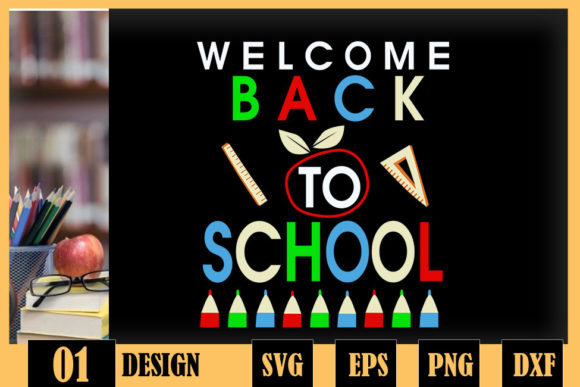
Welcome Back to School Pencil: A Versatile Digital Design Resource for Crafters and Educators
As the back-to-school season approaches, many adults find themselves looking for creative ways to prepare classroom materials, personalize supplies, or launch small projects. Among the digital design assets available, the Welcome Back to School Pencil stands out as a practical and flexible resource. Unlike a single-use clip art image or a basic template, this set of digital files is built to work across multiple software platforms and project types. Understanding what makes it distinct, how it compares to other options, and where it fits best can help you decide whether it meets your needs.
What Is the Welcome Back to School Pencil?
The Welcome Back to School Pencil is not a physical pencil but a collection of digital design files centered around pencil-themed motifs. These files are typically provided in several formats: SVG, PNG, EPS, and DXF. Each format serves a different purpose, allowing users to cut, print, or further edit the design. The kit often includes variations such as single pencils, pencil clusters, and text overlays like “Welcome Back” or “School,” all designed with clean lines and scalable shapes. What makes it distinct is its deliberate compatibility with both popular hobbyist cutting machines and professional design software. Rather than offering only one file type, it covers the spectrum from vector graphics for precision cutting to high-resolution raster images for printing.
Comparing the Welcome Back to School Pencil with Other Back-to-School Design Resources
When evaluating digital back-to-school resources, you typically encounter three categories: generic clip art, themed printable sets, and cutting file bundles. The Welcome Back to School Pencil falls into the third category but with notable strengths. Generic clip art, while often inexpensive, lacks the precision needed for layered cutting projects. Printable sets are excellent for flat decoration but cannot be resized cleanly without losing quality. In contrast, the Welcome Back to School Pencil offers vector-based SVG and EPS files that remain sharp at any size, making it suitable for everything from small sticker sheets to large bulletin board letters.
Another point of comparison is file format flexibility. Many affordable digital designs provide only a single format, typically PNG. That limitation can force you into specific software workflows. The Welcome Back to School Pencil, by including SVG, PNG, EPS, and DXF, gives you the freedom to choose your preferred application without conversion headaches. For example, a Cricut user can import the SVG directly into Design Space, while a Silhouette Studio user might opt for the DXF or PNG depending on their project. An educator using Microsoft Word or Publisher can rely on the PNG for quick resizing and printing. This multi-format approach saves time and reduces the frustration of file incompatibility.
SVG for Cricut Design Space and Silhouette Studio
The SVG (Scalable Vector Graphics) format is the most common choice for cutting machines because it retains all paths and layers. In Cricut Design Space, importing an SVG from the Welcome Back to School Pencil typically preserves the design as a single color layer or multiple layers, depending on how the file was created. This allows you to cut each pencil element separately if needed. Silhouette Studio also handles SVG well, though some users prefer the native DXF format for older versions. For most modern Silhouette software, SVG works without issue.
PNG for Microsoft Office and Silhouette Studio
PNG (Portable Network Graphics) is a raster format that includes transparency. It is ideal when you want to print the pencil design rather than cut it. In Microsoft Word or Publisher, you can insert a PNG, resize it, and place it on backgrounds without a white box. Silhouette Studio can also import PNG for print-and-cut projects, as long as the image has clear registration marks added later. The Welcome Back to School Pencil’s PNG files are typically high resolution (300 dpi), so they look crisp on paper and cardstock.
EPS for Adobe Illustrator
EPS (Encapsulated PostScript) is a vector format preferred by professionals using Adobe Illustrator or Corel Draw. If you need to edit individual pencil shapes, change colors, or add text, EPS gives you full control. The Welcome Back to School Pencil files in EPS format allow you to ungroup elements, recolor them, and export them to other formats as needed. This is especially useful for small business owners who want to create custom school supply labels or teacher appreciation gifts.
DXF for Cricut and Silhouette (Alternative)
DXF (Drawing Exchange Format) is another vector format often used in Cricut Design Space as an alternative to SVG. Some users find DXF more reliable for certain layered projects because it imports as separate shapes rather than a single compound path. The Welcome Back to School Pencil includes DXF files specifically for this purpose. If you experience SVG import issues in Cricut Design Space, trying the DXF version often resolves them.
Strengths and Tradeoffs of Using the Welcome Back to School Pencil
One of the primary strengths is the design’s scalability. Because the core files are vector-based, you can enlarge the pencil design to cover an entire poster without pixelation. This is a clear advantage over clip art that looks blurry when scaled up. Another strength is the thematic cohesion: the set usually includes multiple pencil variations, arrow accents, and school-related phrases, so you can mix and match for a consistent look. For teachers creating a welcoming classroom door or bulletin board, having all elements in the same style saves time.
However, there are tradeoffs. The Welcome Back to School Pencil requires some familiarity with design software or cutting machine interfaces. A complete beginner might feel overwhelmed by file import processes and layer management. Additionally, because the design is digital, you need physical materials such as adhesive vinyl, cardstock, or printable paper. If you prefer a ready-made, printed pencil decoration, this digital resource may not be the most direct solution. Another limitation is that the set’s style is specific—pencil motifs. If your back-to-school theme is more general (e.g., apples, books, globes), you might need additional design elements.
Best-Fit Situations for the Welcome Back to School Pencil
- Classroom Environment Preparation: Teachers who enjoy DIY projects can use the SVG files to cut vinyl decals for door signs, bulletin board borders, and cubby labels. The pencil theme fits well for grades K–5 but can be adapted for older students with color variations.
- Personalized School Supplies: Parents can create customized pencil cases, water bottle decals, or notebook covers using the Welcome Back to School Pencil. The vector format allows resizing to fit any object surface.
- Small Business Merchandise: Crafters who sell on platforms like Etsy can use the EPS files to produce back-to-school sticker packs, iron-on transfers, or treat bag toppers. The multi-format support means you can create both physical cut products and digital printable listings.
- School Event Decorations: PTO or PTA volunteers planning a welcome-back event can design banners, photo booth props, and table centerpieces using the PNG files in Publisher or Word, then print at home or at a local print shop.
When the Welcome Back to School Pencil Might Not Be the Right Choice
If you need an all-in-one, print-ready package that includes a full set of classroom decorations with matching colors and backgrounds, a dedicated back-to-school printable bundle might be more efficient. The Welcome Back to School Pencil focuses on the pencil motif and requires you to assemble each element manually. For someone with limited time or no interest in cutting machines, a simple set of printable PDF posters could be a better fit. Similarly, if your project demands highly realistic or photographic pencil images, the vector-based design in this set is intentionally stylized—it looks like a crisp, modern illustration rather than a photograph.
Decision Factors: Choosing the Right Resource for Your Back-to-School Project
When deciding whether the Welcome Back to School Pencil is the best tool, consider your primary output medium. If you plan to cut vinyl or cardstock with a Cricut or Silhouette, the SVG and DXF files give you exactly what you need. If you plan to print and trim by hand, the PNG format will serve you well. If you intend to alter the design significantly—changing colors, grouping elements, adding text—the EPS or SVG in Adobe Illustrator is ideal. For most hobbyists, the combination of formats within a single purchase is what makes this resource stand out. You are not locked into one software ecosystem.
Another factor is the learning curve. If you are already comfortable with your cutting machine software or vector editing tool, the Welcome Back to School Pencil will feel straightforward. If you are new, start with the PNG in Microsoft Word or Publisher, where you can simply insert, resize, and print. As you gain confidence, explore the SVG for cutting projects.
Finally, consider the aesthetic. The pencil design is cheerful and school-themed, but its clean, modern lines mean it pairs well with other geometric or typographic elements. It does not rely on trendy or overly childish motifs, giving it a longer usable life for annual events.
Practical Examples of the Welcome Back to School Pencil in Action
A teacher preparing her kindergarten classroom downloads the SVG and imports it into Cricut Design Space. She selects each pencil shape, adjusts colors to match her classroom scheme (teal, yellow, and gray), and cuts them from adhesive vinyl. She then transfers the decals onto a whiteboard frame and a classroom door. Meanwhile, using the same set’s PNG files, she creates a “Welcome Back” poster in Publisher, enlarging the pencil graphic to fill an 11×17 sheet and printing it on cardstock. In another instance, a small business owner opens the EPS in Adobe Illustrator, duplicates the pencil, adds a custom name overlay, and exports the design as a cut file for iron-on transfers. The flexibility across these use cases demonstrates why the Welcome Back to School Pencil is more than a one-trick asset.
Weighing Your Options
Digital design resources for back-to-school are abundant, but not all are created equal in terms of format support and scalability. The Welcome Back to School Pencil distinguishes itself by offering a balanced mix of vector and raster files, making it suitable for both precise machine cutting and straightforward printing. Its limitations—the need for software literacy and physical materials—are typical of digital cutting file products. The real value lies in the time saved from not having to convert formats or redraw shapes from scratch. For adults who enjoy creating personalized, durable school items, this resource provides a reliable foundation. If your project calls for something quicker or more comprehensive, other options exist. But for those who want creative control and cross-platform compatibility, the Welcome Back to School Pencil is a well-rounded choice that deserves a close look.